Midlife Crisis

Midlife Crisis

I truly believe that I’m in the midst of a midlife crisis. Everything is coming into focus.

Like a long, flat, tree-lined vista, I see things clearly now.

However, the truths I once held to be self-evident are now obscure and ambiguous. Perhaps those truths are waning.

Truths turning into lies told to me.

Can a truth become a lie?

Or am I falsely learning, indoctrinating myself with bullshit?

I don’t know.

What I do know is that everything I was taught up until this point in my life has gotten me nowhere. I want to believe that the new knowledge I’ve been pouring into myself will guide me toward a healthier life.

But I’m still unhealed, clinging to unhealthy habits.

Some of the old things I’ve learned have become so deeply ingrained in me that I struggle to separate them from who I am.

And that scares me.

Because what if I’m wrong? What if I’m embarking on a path of unrighteousness?

But I’m only following myself.

I’m a good person.

Yet, according to the truths I was taught, the good die young, while these grimy niggas live a long time.

And no matter how hard I try, I cannot be a grimy nigga.

So, yeah.

I’m 38 and having a midlife crisis.

To be or not to be.

Good or grimy.

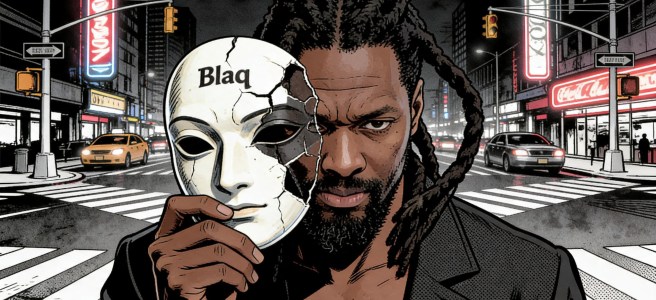
Kory, Shamar, or Blaq.

It’s a wrap for Hussain!

Blaq is a person who doesn’t fit. He’s not the person he needs to be to survive.

Blaq is a façade. A mask I created for the streets to believe that, if necessary, I’ll black the fuck out!

But that mask is what got me here.

He is not me!

But he is.

But he is not.

To let Blaq go is to be free.

Yet I’ve carried Blaq for so long that he’s become a part of me. He’s woven into my identity, stitched into the fabric of who I thought I needed to be.

And now I’m questioning whether the person I created to survive is the very person preventing me from living.

I’m at a crossroads in my life, standing in the middle of traffic, hesitant to move forward and tread my own path.

— Where are you in yours? Tell me in the comments — I read every one. If this piece hit you, hit Like and subscribe so the next one lands in your inbox.

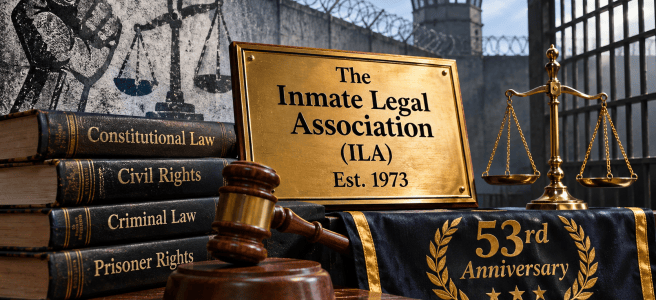
53 Years of Standing on Business: The Inmate Legal Association’s Fight for Justice

By Kory McClary

For 53 years, the Inmate Legal Association (ILA) has been fighting for justice from behind the walls of New Jersey State Prison.

The ILA is a one-of-a-kind, incarcerated-person-run nonprofit organization composed of jailhouse lawyers dedicated to helping the prison population navigate criminal, civil and administrative legal matters.

Founded in 1973 and incorporated in 1974, the organization was established out of necessity to combat the legal inequities incarcerated men faced both inside the prison and in their battles against the State of New Jersey.

According to the ILA’s bylaws, the organization’s purpose is to provide free legal assistance to prisoners, offer instruction, disseminate legal knowledge and fulfill other purposes specified in its certificate of incorporation.

The ILA operates under an executive board consisting of Executive Director Al’Quan White, Director Alonzo Hill, and Allan Mattocks, who serves as both secretary and treasurer.

The organization is divided into five divisions: public relations, federal civil, state civil, criminal actions and administrative actions.

For more than five decades, the ILA has stood on business.

I recently had the opportunity to celebrate that legacy with its members during the organization’s 53rd anniversary banquet, held in the North Compound Visiting Hall at New Jersey State Prison.

During his opening remarks, Executive Director Al’Quan White explained that the anniversary was an opportunity to honor the men who created the organization out of necessity.

“The mission for the coming year is to continue to push a path forward to end mass incarceration in New Jersey,” White said. “Forward is the path.”

Following White’s remarks, members voted to select several individuals for associate and charter membership. Certificates were also awarded to members who completed educational courses and those who secured the most donations, both monetary and nonmonetary.

After the ceremony, food was served, and I had an opportunity to interview several members about the organization’s history, accomplishments and ongoing challenges.

A Legacy of Legal Resistance

Bobby Brown, who has been a member of the ILA for more than 25 years, believes the organization’s longevity comes from its ability to turn legal knowledge into meaningful action.

According to Brown, the ILA has effectively applied its knowledge in criminal, civil and administrative law to challenge injustices within the prison system.

He considers the organization’s lawsuit against the superintendent of Trenton State Prison, now known as New Jersey State Prison, one of its greatest accomplishments.

In Valentine v. Beyer, filed in 1985, the ILA sought declaratory and injunctive relief to prevent prison officials from arbitrarily depriving incarcerated individuals of rights guaranteed under the United States Constitution.

At the center of the dispute were restrictions imposed by the prison administration that limited the ILA’s ability to communicate with incarcerated people seeking legal assistance.

The court ruled in the ILA’s favor.

“The lawsuit has given the ILA long standing and enables them to litigate against the administration, despite the administration’s continuous efforts to shut the ILA down,” Brown said.

For James Martin, who joined the ILA in 1997, the organization’s future depends on educating the next generation of incarcerated men.

He hopes the ILA continues to grow while passing its legal knowledge to younger men entering the prison system.

“It’s important because most people know nothing about the law,” Martin said. “It’s imperative for the ILA to teach them.”

The Challenges of Fighting for Justice

Despite its accomplishments, the ILA continues to face significant obstacles.

Juan Turner, the organization’s civil division director, believes one of its greatest challenges is a shortage of experienced litigators.

Turner describes New Jersey State Prison as a functioning constitutional violation and argues that more incarcerated men need to become involved in challenging the conditions they face.

“With more litigators the fight will be stronger,” Turner said. “We need collectivity.”

Funding is another obstacle.

Allan Mattocks, the ILA’s executive secretary and treasurer, says securing grants and donations remains one of the organization’s biggest challenges.

“The more funding we have the more we’ll be able to assist,” Mattocks said.

For Director Alonzo Hill, some of the most pressing legal inequities involve incarcerated people’s limited access to the courts and legal resources.

Hill points to the inability of incarcerated individuals to electronically file state and federal appeals as a significant disadvantage.

Without access to electronic filing, incarcerated litigants must rely on the United States Postal Service, a process that can be costly and create delays.

“Using the United States Postal Service, a person’s mail is not guaranteed to arrive on time,” Hill said. “Then it’s on us to prove that we were timely.”

Hill also criticized what he describes as the prison administration’s continued efforts to restrict access to the law library and other legal resources.

“They create policies to limit legal access,” Hill said, pointing to restrictions involving digital discovery as another obstacle.

These limitations can make an already difficult legal process even more challenging for incarcerated men attempting to defend their rights.

The Fight Continues

Over the years, the ILA has helped incarcerated men confront these legal inequities through grievances, dialogue with prison officials and litigation.

Sometimes those efforts produce meaningful victories. Other times, the challenges persist.

But for the men of the ILA, the fight for justice does not end with a courtroom defeat, an unanswered grievance or another restriction imposed by prison administrators.

The organization was born out of necessity, built on legal knowledge and sustained by incarcerated men willing to fight for the rights of others.

Fifty-three years later, that mission remains unchanged.

And as White reminded those gathered at the anniversary banquet, “Forward is the path.”

— Should people inside have their own lawyers fighting for them like this? Tell me what you think in the comments. Like and subscribe for more reporting from inside.

Dear Diary 11

Affirmation: I may fall, but I will always rise with a new plan, a stronger mind, and another reason to fight for my freedom.

Dear Diary,
What’s the deal?
Sometimes I feel like I’m not doing enough to get myself free. Then I ask myself, What more can I do? What else can I try to achieve my freedom? Maybe I need to write more advocates. More organizations. More people who might be willing to look at my case and help me navigate these legal woes.
I’ve tried before. At one point, I actually found some rhythm with an organization called Centurion. We communicated through letters for about two years. They seemed genuinely interested. They asked relevant questions about my case, and eventually, they took a closer look at what I had been screaming about. They saw the injustices I was talking about. For a while, I was convinced they were going to help me get back into that courtroom.
I was wrong.
Eventually, I received a letter telling me they couldn’t help me. When that letter hit, I was crushed. I had become so high on the possibility of their help that when the possibility disappeared, I sank low. Real low.
But I got back up. And maybe that’s what life is about. You fall, You get back up. You dust yourself off. And you get back to it. That experience discouraged me, but it also taught me something: I have to keep knocking on doors.
So maybe I need to write more institutions. More advocates. More organizations. Maybe the next letter I send finds the right person at the right time. I have to keep trying. Because I have to get out of here by any means necessary.
This place is inhumane, and it seems to become more so with every passing day.
It’s been eighteen years since I last felt the breath of freedom. Eighteen years.
Dear Diary, what more does a man need to be free besides being a part of humanity? Should a man be condemned to die in an unfree state? I’m not judging. I’m just wondering.
And while I wonder, I’ll keep writing. I’ll keep learning. I’ll keep knocking. I’ll keep fighting. Because if one door closes, I have to find another one. And if there isn’t another door? I’ll build one.
Dear Diary, spread my words across the earth and into the world:
Kory McClary is ready to be free.
Peace,
Kory

#GoEagles

What are your favorite sports to watch and play?

I was born a Philadelphia Eagles fan. I grew up in the ’90s where the average kid my age was either a Dallas Cowboys fan or a 49ers fan. It was a hard time growing up repping the birds. Where Randal Cunningham left the team and a winning season was hard to come by. It was especially hard when Dallas was winning like a mother fucker. However, I stayed true. I knew unlike my friends that the Eagles would one day received the glory. But when?

“The Eagles will never win a super bowl!” My cousin would say. “Yes we would!” I would respond. Sure but not so Sure because Koy, Troy and Ray Rhodes were not getting the job done. The preteen me would sit in front of my mom’s floor model TV and cry as we lost game after game. When, will the losing stop? I often wondered.

Then with the second pick in the 1999 draft the Eagles selected Donovan McNabb. Hold up, why did these idiots select McNabb, when everyone expected them to select Ricky Williams the running back. Everyone thought McNabb would be a bust. Well they turned out to be wrong. And McNabb panned out.

The Eagles began to win games. And not just games but, we had winning seasons. ’01, ’02, ’03 all led to NFC championship appearances. I knew a super bowl was on the precipice and the victory will be mine. I couldn’t wait to throw it in my cousin’s face.

It was Superbowl XXXIX, and and the Philadelphia Eagles were there. 19 years and coming, finally I would get a ring. All that we had to do was beat the great Tom Brady. McNabb threw it up literally. So no Superbowl. At least not that year. Nor, the next year and not the next. And my cousin’s voice rang in my ear, “The Eagles will never get a Superbowl.”

True to my fandom I stayed down. Michael Vick came we won games but not the dance. More laughs from my friends and more losing seasons. And still no ring. Then with the number two pick of the 2016 draft the eagle selected Carson Wentz.

Carson Wentz along with Coach Doug Peterson led the Eagles back to the Great dance however in the process Wentz went down. And I couldn’t help but wonder, would we win the super bowl? Our back up was an experienced veteran, Nick Foles. Could Foles get the job done? And yes he could. In 2018, the Philadelphia Eagles won their first Superbowl. And I experienced the joy of finally having a ring. In the words of the great Ric Flair “Woo!”

Now the Cowboys fans’ argument is, Dallas has more rings than the Eagles. They make this argument even though they haven’t been to the great dance in over 25 years. Ok cool. The Eagles, coach Sirianni and the great Jaylen Hurts are on their way to another ring. Will they get it done? The fan in me says, hell yeah and go Eagles! This is a lesson to myself and others, for staying down, and staying true and seeing a dream come true. #goeagles

Give Me Back My Voice

The time then has arrived, Glaucon,
When, like huntsman, we should surround the cover and look sharp that Justice may not steal away, and pass out of sight and escape us; for beyond a doubt she is somewhere in this country: watch therefore and strive to catch a sight of her, and if you see her first, let me know… (This quote is from Socrates, in his pursuit of justice.)
See I’ve been looking for lady Justice myself, and it seems like she’s been avoiding me specifically. Like Socrates, I’ve enlisted the help of my friends and family, but their interest in justice is not as keen as mine, so when they spotted her she stole away.
My family and friends were there when justice was stolen from me. Now I sense that they believe since she’s gone, she’s gone forever. But they don’t understand the hunt.
So here I sit with foggy binoculars, and I’m looking for her.
It all happened On August 28, 2013: I was in a fierce battle against the state of New Jersey, for my freedom. It was the thick of the rumble: jury deliberations. I waited in angst for a verdict in a holding cell in the back of courtroom number five, where the jury deliberated my fate… Guilty or innocent
At 12:15 PM, the sheriffs escorted me out of the holding cell back into judge Delury’s Court room. “The jury sent a note marked as C-19.” Said the judge.
“The note read ‘believes that one of the people on the jury came in with a decision made that all non-police witnesses are not credible, only the police department is credible’ ”. Juror number 9 wrote the note.
I sat at the defense table listening through HEADPHONES while the judge, the Prosecutor, and my attorney had a sidebar conversation.
The conversation ultimately led to them agreeing to allow the jury to deliberate undisturbed.
I was returned to the holding cell to await my fate. “Please lord don’t let me get found guilty tonight” was my prayer.
I paced the concrete floor wondering how should I feel about the note? Good or bad? I didn’t know. I paced the cell worried, but strong, uncertain, but content with my Lord’s plan.
“ANOTHER NOTE!” The sheriff yelled as he banged on the plexiglass window to the holding cell.
“Another note?” I wondered as I was being escorted back into the courtroom
I smiled at my family who filled the rows behind me. They seemed worried
We all listened as the court Read the note onto the record.
The forewoman wrote “Juror number 4 is not impartial to the witnesses and refuses to accept circumstantial evidence. We cannot move on at this point with 11-1. ”
At this point, I believed that this numerical split “11-1” meant a hung jury, and I would have to be retried.
I was wrong!!!
The looks that were on the faces of my family members was painful. I smiled, even though my heart was being ripped from my chest.
My lawyer was whispering something in my ear, my heart was beating, and I was wondering in whose favor was the jury?
The elusive answer was lurking within the thick tension inside courtroom number 5.
I was hoping that the world would never know, cause I had a feeling that all these white old people, that made up a jury of my peers, was not letting a nigga go.
The court called the jury Into the courtroom. Twelve angry white jurors.
The judge asked the jury “will further deliberations help you to reach a verdict?”
The forelady replied with a curt “No!”
After admonishing the jury with an instruction, to keep deliberating, the Court sent the jury back into the jury room
“Whew!” This shit is getting thick, and it seemed like all of these Court officials were on some bullshit, and my peoples were feeling the same way. Judge agreeing with the prosecutor, and my lawyer just mumbling shit.
Though I was concerned I kept my composure, remaining firm for my family, and after all they were 11-1. That elusive answer still remained:
IN WHOSE FAVOR WAS THE JURY?
They could still be in my favor. I had hope.
Immediately after sending the JURY back TO DELIBERATE, THE COURT WAS BACK ON RECORD. “UNDER UNUSUAL CIRCUMSTANCES, I CALLED JURY NUMBER 9 INTO MY CHAMBER’S TO DISCUSS THE NOTE SHE SENT.”
“What!?” I knew deep in my heart that this was wrong. How could a judge speak to a Juror outside the presence of me and my lawyer. The fix was in.
My back was against the ropes, the ref was throwing low blows, and the contender was throwing haymakers. What’s a nigga to do? I prayed.
Now, whatever discussion the judge had with Juror nine he learned what was supposed to be the secrecy of deliberations. He knew in whose favor the jury was.
Now, he would work it.
The judge called each juror out of the jury’s room one by one, asking them about their feelings in regards to juror four; the lone dissenting juror.
In the face of all the above, Juror number four switched his not guilty into a guilty—and the judge sentenced me to one hundred thirty years.
Damn!
Strapped with the memory of my trial, I did a lot of research on ex parte communications between a judge and a deliberating juror, so that I could be ready for the appellate division.
When I received the transcripts to my trial, I immediately noticed that the transcripts were not reflecting the unusual event between the Court and juror number nine
“Hold up!” I said to myself “this can’t be right”
I wrote to my appellate attorney. Explaining that, something was missing from the transcripts, and we needed the Sound Recording to my trial
My attorney wrote back saying that she spoke with the stenographer ADELE TALASNIK, and the stenographer does not have this event that I complained about happening in her stenographer notes, and my trial was NOT SOUND RECORDED.
Damn!
It was clear from the letter that my attorney didn’t believe me. I read the letter several times. The stenographers name sticks out. Adele Talasnik.I just couldn’t put a finger on it.
I ask my self why was my trial not sound recorded, in this day and age, is this even true?
I dig in, doing my research on trial recordings and a stenographer’s duty. I refused to allow anyone to tell me what happened at my trial, didn’t happen.
One day while going through some paper work, I came across the name MURRAY TALASNIK. He was the prosecutor that took my case to the grand jury, and signed a warrant in my case.
Wow!
Adele Talasnik and Murray Talasnik are married! It all added up. Murray Talasnik had a complete interest in the outcome of my case. No wonder why they doctored the transcripts.
At this point I’ve done everything that I could do. I filed motions, wrote, called, researched, and wrote some more. My family members spoke with Adele Talasnik, and she told them my trial was NOT sound recorded.
I spoke with the supervisor of court reporters, Camille Pedano Horner. I explained to her that Adele Talasnik was married to the prosecutor in my case. She told me not to believe everything that I hear…
Bitch I Googled it!
Through correspondence with the Administrative Office of The Courts, Karen M. Carroll wrote me and told me that every courtroom in Atlantic County is equipped with sound recording technology.
If the courtrooms in Atlantic County are equipped with this technology why wasn’t my trial sound recorded? And who determines when it’s on or off?
It has taken me years of research in the outdated law library that I have access to, but eventually I found the law that said it was against the law for Adele Talasnik to record my trial since she was married to the prosecutor. New Jersey Court rule 4:12-4, says that Adele Talasnik should’ve been disqualified…
This made it clear that Adele Talasnik broke the law.
Finally on October 1, 2020, the Board of Court reporters, sent me a vague letter, saying that they would open an investigation on Adele Talasnik.
It’s now 2022, and I still haven’t heard anything… Not even a response to my follow up letters.
It seems like nobody cares and no one’s listening. I Feel like my voice has been taken. Like so many other brothers incarcerated by injustice. So, I write and speak with ink. I refuse to be silenced by this crooked ass system….
GIVE ME BACK MY VOICE BITCHES